
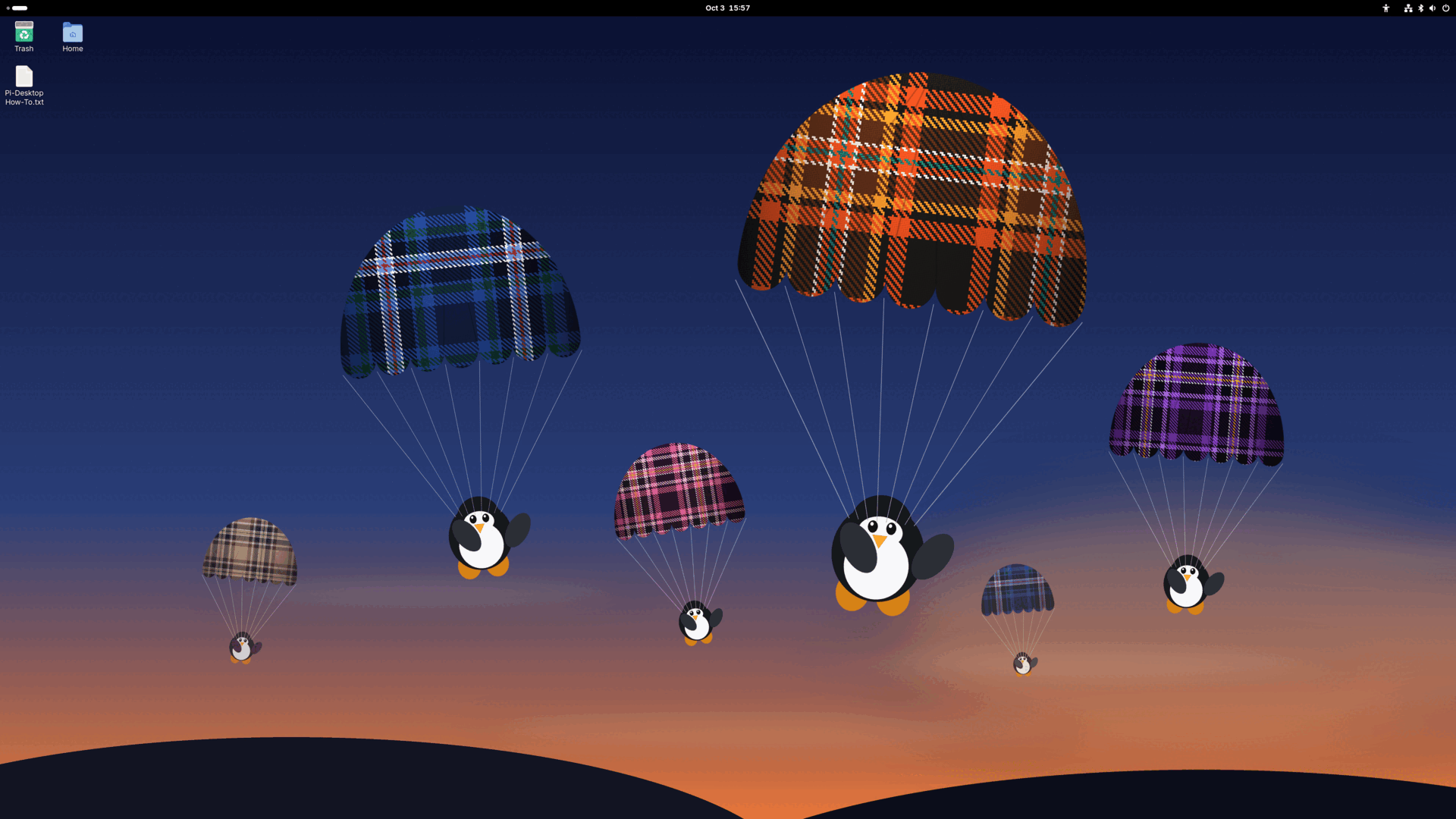
What it is
Two desktop images built from Ubuntu 26.04 packages with the Armbian build framework, on Armbian's Rockchip vendor kernel merged with upstream stable Linux plus the Plaid Pi kernel patches: Plaid Pi Plus 6.5 for the Orange Pi 5 Plus (RK3588; KDE Plasma 6.6 on Mesa's open Panthor GPU driver, kernel 6.1.191) and Plaid Pi 6.0 for the Orange Pi 5B and Orange Pi 5 (RK3588S; GNOME 50 on Arm's Mali driver, kernel 6.1.189). Not affiliated with or endorsed by Canonical or Armbian. Not a Raspberry Pi product.
The 6.5 image was checked on an Orange Pi 5 Plus (2026-11-17: 150 of 150 first-boot checks, again after Pro Updates and its first-click apps); it adds KDE Plasma, Cinemosk (a picture-settings window for films, with the GPU cost of each setting measured on the board), DVD and Blu-ray folder playback in mpv 0.42, GStreamer 1.28.9 and kernel 6.1.191 — the CHANGELOG has the list, KNOWN-ISSUES HW-2 what was not tested on the 5 Plus (eMMC, the Broadcom Wi-Fi module).
Everything below was checked on an Orange Pi 5B: on the 5.0 release image (2026-10-19: 133 of 133 first-boot checks passed, and again after all seven first-click apps and Pro Updates had run), again on the 5.5 release image (2026-10-22: 147 of 147) and on the 6.0 release image (2026-10-26: 152 of 152), unless an item says it was measured on 4.0.
- 4K at 120 Hz over HDMI. The vendor kernel reaches HDMI 2.1 FRL with our clock patches; the three ways it failed on the way there (black screens, a hang on screen-off, a black screen after a monitor power-cycle) are fixed by kernel patches, each re-tested on hardware.
- Flicker-free. On the 6.0 image Arm's Mali user-space driver instead of Mesa panfork, on the 6.5 image Mesa's open Panthor driver, and AFBC scanout rejected in the kernel on both. The Chromium typing and thumbnail flicker of 2.0.x is gone.
- Hardware video, 10-bit and AV1 included, in Chromium (shipped on the 6.0 image, a first-click install on the 6.5 KDE image). Our rockchip-vaapi driver 4.0.0 on our build of Rockchip's MPP library. Measured on 4.0 (2026-10-03): Chromium decodes a 4K HEVC Main 10 file on the video engine — 595 frames, none dropped, about a fifth of the CPU — so Jellyfin direct-plays 10-bit with no server transcode, out of the box; Chromium is 155 in 5.0. VP9 now runs on both decoder cores (see Dual-core VP9 below). AV1 is new in 5.0: Firefox, installed on first click with our small Mali library, plays YouTube 4K60 AV1 on the video engine with 1.2–1.5 % of frames dropped after start-up, where driver 3.0.0 dropped 91–95 %; Chromium and Chrome start AV1 playback clean in 10 of 10 measured first plays. mpv goes through VA-API, with profiles for DVDs and Blu-rays.
- The Number Nine Pepper video driver. Our VA-API driver, rockchip-vaapi 4.0.0 "Pepper Pro", hands video to the RK3588's video engine, so Chromium, Chrome, Firefox and mpv decode H.264, HEVC, VP9 and AV1, 8- and 10-bit, in hardware (the known-issues file lists the exceptions). 4.0.0 rebuilds the H.264 and HEVC headers per picture, so most of the streams earlier releases decoded wrong now decode bit-exact: H.264 conformance 74 → 111 of 135, HEVC 17 → 141 of 147. For AV1 it rebuilds the headers MPP needs from the VA-API parameters, and with our MPP build each picture is decoded once. A fork of Eduardo García-Mádico Portabella's driver: defcom5-rockchip/rockchip-vaapi. Number Nine is a tribute to the 1980s graphics-card maker, whose Pepper co-processor boards name the releases; not affiliated with or endorsed by Number Nine or the successors to its assets.
- Dual-core VP9. The RK3588's two video decoder cores work on VP9 together again. A frame label that the hardware compares in 16 bits made both cores reset after 65,536 frames (about 18 minutes of 60 fps video), so upstream MPP and Plaid Pi 4.0 decoded VP9 on one core. Our fix wraps the label where the hardware does; Rockchip's reviewer accepted it (rockchip-linux/mpp#976). In Rockchip's test decoder, 4K60 VP9 runs 44 % faster for 10-bit and 29 % for 8-bit than on one core.
- Full-screen video capable. 4K video decoded on the video engine (H.264, HEVC, VP9 and AV1, 8- and 10-bit) and drawn zero-copy by mpv, full screen on a 4K monitor at 120 Hz; on the GNOME image the screensaver already loops a film full screen. 10-bit 4K at 60 fps uses most of the GPU, and 4K60 10-bit AV1 drops most frames in mpv for now (VID-9).
- Netflix and Prime Video in the browsers (new in 6.0). Install Google Chrome with one click; Chromium and Firefox then use Chrome's Widevine module too, so keep Chrome installed (nothing is copied; it stays Google's install). Checked on the 6.0 test builds: Netflix plays in Chrome, Chromium and Firefox, Prime Video in Firefox and Chrome, and the sign-ins survive a reboot; other services using Widevine were not tried. Linux gets Widevine's software level, so the video is decoded by the CPU, not the video engine, and services choose the quality: Netflix sent 1080p at 24 fps, Prime Video standard definition.
- Films from a NAS without skips (new in 5.5). Network Drive (Utilities, or right-click a share in Files ▸ Add as Network Drive…) adds the share as a drive that reads 32 MiB ahead, so a short pause on the NAS doesn't interrupt the film; in a two-hour test a 4K AV1 film played from one in Firefox with no decoder stall.
- Wi-Fi joins WPA3 and WPA2/WPA3 networks. A one-branch bug in the vendor Wi-Fi driver refused every modern home network with Ubuntu 26.04's wpa_supplicant; fixed, and merged by Armbian into its vendor-kernel branch on 2026-10-21 (armbian/linux-rockchip#561).
- Bluetooth that survives Wi-Fi. The AP6275P boot-race and coexistence fixes from 2.0.x, carried over with the self-healing sentinel. The ten-second mute at every YouTube ad on a Bluetooth speaker is gone.
- Audio. PipeWire 1.6.10 with real-time priority from boot; the 3.5 mm jack works and follows plugging; Rhythmbox 3.5.1, Audacity, Brasero.
- Screensaver instead of blanking on the GNOME image (the KDE image uses Plasma's power management), lock on demand, a login screen at every boot with the Plaid Pi logo on it.
- Fixes you would otherwise find yourself. GUI password prompts that hang on Ubuntu 26.04 with a 6.1 kernel; a large file copy that could get the whole session killed; every board called "pidesktop".
- Small image, apps on first click. 1.39 GiB compressed (6.0; 6.5: 1.48 GiB). Firefox, LibreOffice, GIMP, Inkscape, Thunderbird, VSCodium and Google Chrome download from their own repositories on the first click; all seven ran on the 5.0 image on hardware.
- No default passwords. The first boot has you set your own; root cannot log in over SSH with a password, only with a key; system changes ask for your password, and Network Drive logins are stored readable by root only.
- Updates by themselves. Ubuntu's security updates and the browsers' own repositories update daily; Pro Updates 1.5.0 shows and applies the rest when you open it. The kernel and boot packages are held and change only with Plaid Pi releases.
- No snaps. No telemetry of our own. What the base still talks to is on the privacy page. Armbian's browser policies (start page, bookmarks) are not applied since 5.0.
Honest scope
Supported boards: the Orange Pi 5 Plus (the 6.5 image, built for it and tested on it), the Orange Pi 5B, which the 6.0 image is built for and tested on, and the original Orange Pi 5, which uses the 5B image (same chip; the 5B's device tree is the 5's plus the eMMC and the Wi-Fi/Bluetooth module, minus the SPI flash). We have no Orange Pi 5 to test on, and nobody has reported 4.0 or later on a 5 yet, so the 5 is supported through issues, pull requests to the recipe and Discussions (KNOWN-ISSUES HW-1). Orange Pi 5 Plus: its own image from 6.5 (KDE Plasma), tested on one board here; KNOWN-ISSUES HW-2 lists what was not tested (eMMC, the Broadcom Wi-Fi module).
One maintainer, a vendor 6.1 kernel, best effort. It ships a KNOWN-ISSUES file on purpose — we'd rather tell you what's rough than let you find out. Suspend is disabled. 10-bit video is hardware-decoded in Chromium, Chrome and mpv, and in Firefox (on the GNOME image through our launcher library); AV1 in Chromium can show a rare stale frame mid-stream. On long 10-bit VP9 transcodes, the video library most RK3588 images ship drops about 30 % of the frames — measured here, root cause found and the fix sent upstream; Plaid Pi is not affected. HDR on the maintainer's monitor stays pale, and that is the monitor. The Orange Pi 5B and 5 have two display outputs, HDMI 2.1 and DisplayPort over USB-C, nothing else (the 5 Plus adds a second HDMI output and an HDMI input, untested here: HW-2); a passive HDMI-to-DisplayPort adapter cannot work on any computer.
Security updates for the Ubuntu packages come from Ubuntu's repositories for the life of 26.04. The kernel and boot packages are built from Armbian's branch, merged with upstream stable by Plaid Pi, and refreshed with Plaid Pi releases: a new kernel means installing the new image. Plaid Pi's own packages are updated with releases. There is no guaranteed support period and no commercial product behind this. The security page says how to report a problem.
The recipe is public
Built on Armbian, by hook. Plaid Pi images are built from pinned Armbian build-framework inputs. Armbian owns the RK3588 boot chain: U-Boot, partition layout, kernel branch, device trees, modules, firmware, board-support packages and the first-boot filesystem resize. Plaid Pi changes the kernel there: upstream stable 6.1.191 (6.5) or 6.1.189 (6.0) merged into Armbian's branch, and its own patches (25 in 6.5, numbered 0001–0028 with gaps; 0001–0017 in 6.0) applied through Armbian's own userpatches mechanism, all published with the source. Everything else is a userspace layer applied through Armbian's late image hook, customize-image.sh, and every line of it is in the recipe repository. The images are credential-free: there is no default user or password, the first boot creates yours.
Don't trust the image; audit the recipe.
- Recipe — build config, customize script, overlay, kernel patches, package build scripts: defcom5-rockchip/pi-desktop-recipe.
- Kernel — Armbian's
rk-6.1-rkr7.2at44bbd021merged with upstream stable v6.1.191 (6.5: tagpi-desktop-6.5, the Plaid Pi patches applied from the recipe at build time) or v6.1.189 (5.0–6.0: tagpi-desktop-5.0, all but one patch also as commits on the tag; 4.0: tagpi-desktop-4.0): defcom5-rockchip/linux-rockchip. - Video driver — defcom5-rockchip/rockchip-vaapi, release v4.0.0.
The legal page has the complete corresponding-source table, the licences and the trademark notes. The 2.0.x line on ubuntu-rockchip was retired at v2.0.2; the changelog has the history.